



By Ada
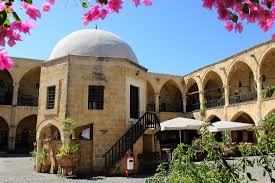
Büyük Han was built between 1572 and 1579 by Sinan Pasha, the Ottoman Governor of Cyprus. It reflects the typical architectural characteristics of Ottoman urban trade inns.
In the past, it was constructed to accommodate merchants and visitors coming to the old bazaar from both within the island and abroad. With its courtyard plan, arcaded structure, and two-storey rooms, it served as an important center combining both accommodation and commercial functions.
Today, Büyük Han serves as a cultural and tourist attraction, featuring shops where traditional handicrafts are displayed and sold, souvenirs unique to Cyprus, an authentic Turkish coffee house, and restaurants offering distinguished examples of local cuisine.
Büyük Han is one of the most significant surviving architectural monuments from the Ottoman period in Cyprus and is regarded as the largest historic inn on the island. It was built following the Ottoman conquest of Cyprus in 1571 to revitalize commercial life on the island.
Architectural Features
The building is arranged around a large rectangular inner courtyard. The ground floor contains rooms used as storage and commercial spaces, while the upper floor houses accommodation rooms. In the center of the courtyard stands a small domed kiosk mosque (köşk mescit). The arcaded (arched) galleries reflect the typical features of Ottoman city inns. Constructed of cut stone, the building has a solid and monumental appearance
Historical Background
During the Ottoman period, Büyük Han was an active center of trade and lodging. Under British colonial rule, it was used for various purposes, including serving as a prison for some time. After years of neglect, the building was restored in the late 20th century and reintegrated into cultural life.
Büyük Han Today
Today, Büyük Han is a vibrant cultural and tourist hub that attracts both locals and visitors. It houses:
- Handicraft workshops – where artisans create and display traditional Cypriot crafts.
- Art galleries – showcasing local and contemporary art.
- Shops selling traditional Cypriot handicrafts and souvenirs – perfect for unique gifts and keepsakes.
- An authentic Turkish coffee house – offering the classic experience of Turkish coffee in a historic setting.
- Restaurants serving local and traditional cuisine – providing a taste of Cypriot flavors and specialties.
In addition to shopping and dining, the central courtyard often hosts live music performances, cultural events, and seasonal festivals, creating a lively and nostalgic atmosphere. Visitors can stroll through the arcaded galleries, enjoy the historic architecture, and experience the rich cultural heritage of Cyprus.
Büyük Han has become more than just a historical site; it is a living center of art, culture, and social life, bridging the island’s Ottoman past with contemporary cultural experiences.
Lefkoşa (Nicosia) – Historical Overview
Lefkoşa, the capital city of Cyprus, has a rich history that spans over 4,500 years, making it one of the oldest continuously inhabited cities in the Eastern Mediterranean. Its strategic location at the center of the island has made it a key political, commercial, and cultural hub throughout history.
Ancient and Medieval Periods
- The area around Lefkoşa has evidence of Neolithic settlements, showing early human habitation.
- During the classical and Hellenistic periods, the city developed under Greek and Roman influence.
- In the Byzantine era, Lefkoşa became an administrative and religious center, with several churches and fortifications built to protect it from raids.
Lusignan Period (1192–1489)
- After the Third Crusade, Cyprus came under the rule of the Lusignan dynasty, who established Lefkoşa as the island’s capital.
- The city was fortified with walls, towers, and gates to defend against invasions.
- Many Gothic-style churches and palaces were built, reflecting the European medieval influence.
- Lefkoşa became a center of trade and culture, connecting Europe, the Middle East, and the Mediterranean.
Venetian Period (1489–1571)
- The Venetians took control and strengthened the city’s fortifications, building the famous Lefkoşa walls that still define the city today.
- During this period, the city’s streets and gates were reorganized for defense and administration.
- Many churches and civic buildings were adapted for Venetian use, blending Gothic and Renaissance architectural styles.
Ottoman Period (1571–1878)
- The Ottomans conquered Cyprus in 1571, and Lefkoşa became the administrative center of the island.
- Many mosques, baths (hamams), caravanserais (like Büyük Han), and markets were built, shaping the city’s Ottoman character.
- The walled city was divided into quarters for Muslims, Christians, and Jews, with each community having its own mosques, churches, and synagogues.
- Lefkoşa flourished as a center of commerce, religion, and education during this period.
British Colonial Period (1878–1960)
- Lefkoşa became the capital under British administration after Cyprus was leased to Britain in 1878.
- Modern infrastructure was introduced, including roads, schools, government buildings, and hospitals.
- The city expanded beyond its historic walls into new districts influenced by British architecture and urban planning.
Modern Period (1960–Present)
- After Cyprus gained independence in 1960, Lefkoşa continued as the capital of the Republic of Cyprus.
- Following intercommunal violence in the 1960s and the Turkish intervention in 1974, the city was divided by the Green Line, separating the north (Turkish Cypriot) and south (Greek Cypriot) sides.
- Today, Lefkoşa remains a political, economic, and cultural center, with a blend of Ottoman, Venetian, British, and modern influences.
Lefkoşa’s history is reflected in its narrow walled streets, historic buildings, mosques, churches, and markets, making it a living museum of the island’s complex and layered past.